
Summary: A 45-minute escape room, designed in 3 hours as part of a team at Metagame 2025!
Responsibilities: Game Design, Puzzle Design, Game Manager
At the Metagame 2025 convention, I participated in a 3-hour escape room game jam as a team of 6. The room was run 8 times on the last day of the convention instead of the planned 4 due to popular demand, with teams ranging from 4 to 8 players. I was responsible for the core mechanics of 3 of the puzzles, and had a hand in changing and improving every puzzle from playtest feedback.
By the end of the convention, the escape room had 8 core puzzles spread across 4 seperate rooms, including a room behind a hidden bookshelf door.
Escape Room Narrative: It’s your birthday, and guests are arriving in 45 minutes, but your parents aren’t here to host the party! You haven’t seen them since they went into their bedroom this morning. Find your parents before the guests arrive!


Quotes From Players
- “I’ve paid for worse escape rooms!”
- “This was easily the highlight of Metagame for me”
- “This escape room was amazing!”
- “Your escape room elevated my entire convention experience”


Puzzle Highlight: Map Finale
This puzzle saw the greatest number of changes over the course of the convention, to calibrate the difficulty and mechanics of the puzzle.
The experience for this section was centered around aligning hourglasses correctly on the map, and everything flipping them simultaneously. This ensured that all players are participating in the final action of the game together, and are in the same location, allowing game masters to secretly perform actions.
Changes Made: The methodology to identify where the egg dramatically changed to a different type of puzzle entirely, as the first iteration was too difficult and frustrating for players. Additionally, the first version of the displayed calibration code had two valid answers depending on the players’ interpretation of the narrative. This was unsatisfying for players, so it was changed to ensure that there was only one possible correct answer, while also adding two other calibration sheets to ensure that players had solved a puzzle earlier in the experience.


Puzzle Highlight: Blinds
This puzzle took advantage of the affordances of the room, where turning the blinds would reveal a number or letter that would be used for a lock.
Of the 4 blinds in the room, 3 had a letter or number, and were set up such that one blind immediately showed the value when dropped, while the other two had to be dropped and rotated to show the value.
This gave the players an immediate reward for closing the blinds, while leaving the opportunity for them to feel clever for identifying that they needed to rotate the blinds.
Changes Made: The original code given from this puzzle was 65KK, a subtle reference to a later part of the room. Unintentionally, this 65KK was used as a combination twice in the room, breaking conventional escape room rules. The code was changed to 56CK and another puzzle was added to seperate these values.
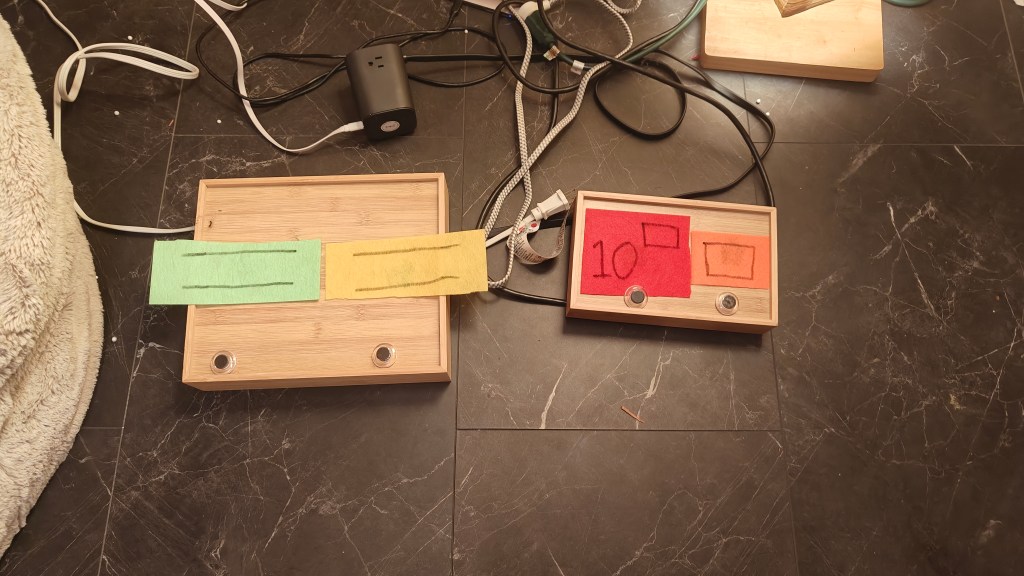
Lock Highlight:
Time Calibration
One of the last locks in the escape room, players had to find the correct components around the room, and set the values correctly to “open” the lock. Although mechanically simple, this puzzle had some of the most impactful changes made.
Changes Made: The most important changes made to this lock were centered around communication and player flow.
Player Flow: These values were set closer to another major element in the room, but caused players to all bunch on one side of the room. Moving this lock to the other side of the room split the players into more managable sizes and allowed more members to participate.
Communication: To highlight that this was an interactive piece, the mess of cables was added to make the display look like it could theoretically communicate to other parts of the experience, and make it feel like part of a larger machine.
Communication: The greatest change was the black magnets on the bottom of each display. Players were unsure if they had inputted the correct value for each element, so I added these magnets that when flipped over showed white. This took the place of LEDs, and gave players confidence that they were moving in the right direction.
 percegaming
Leave a comment