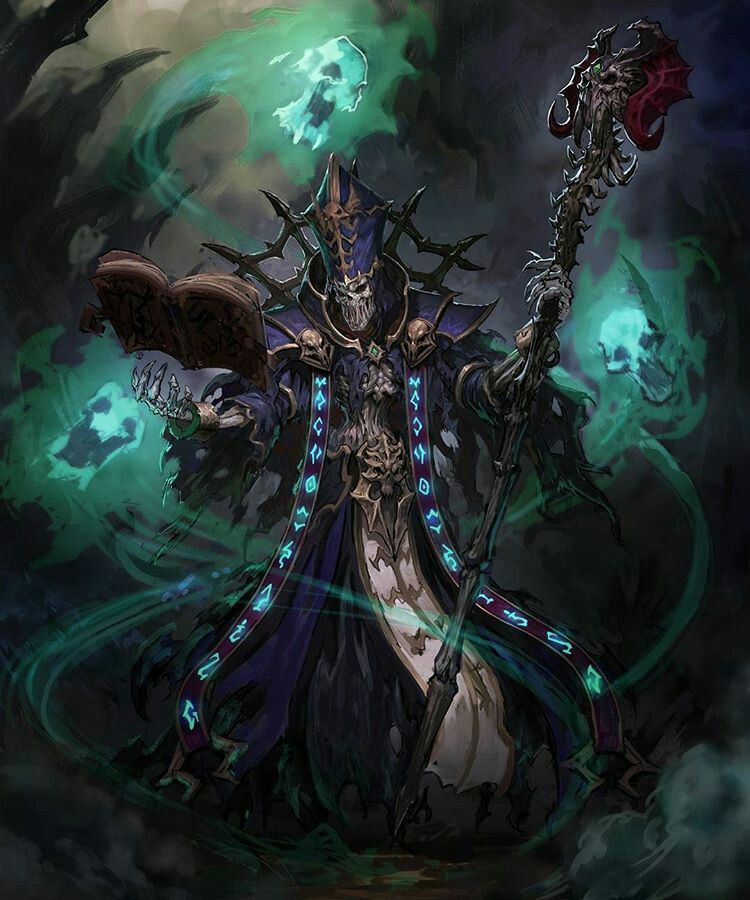


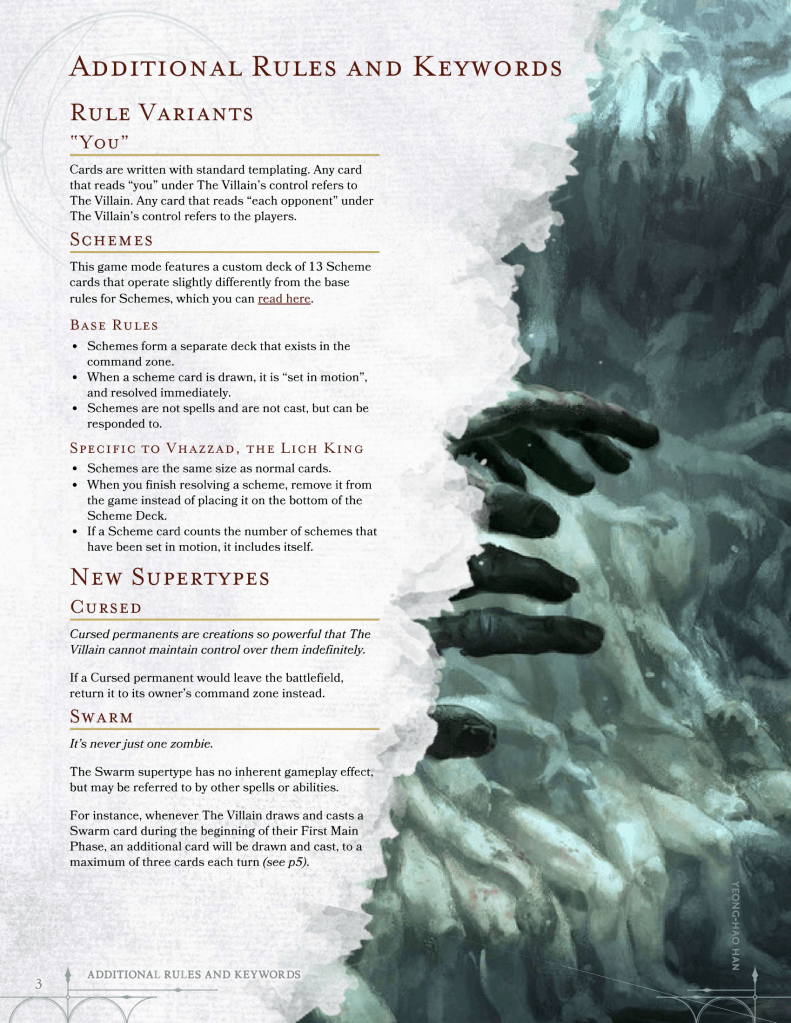

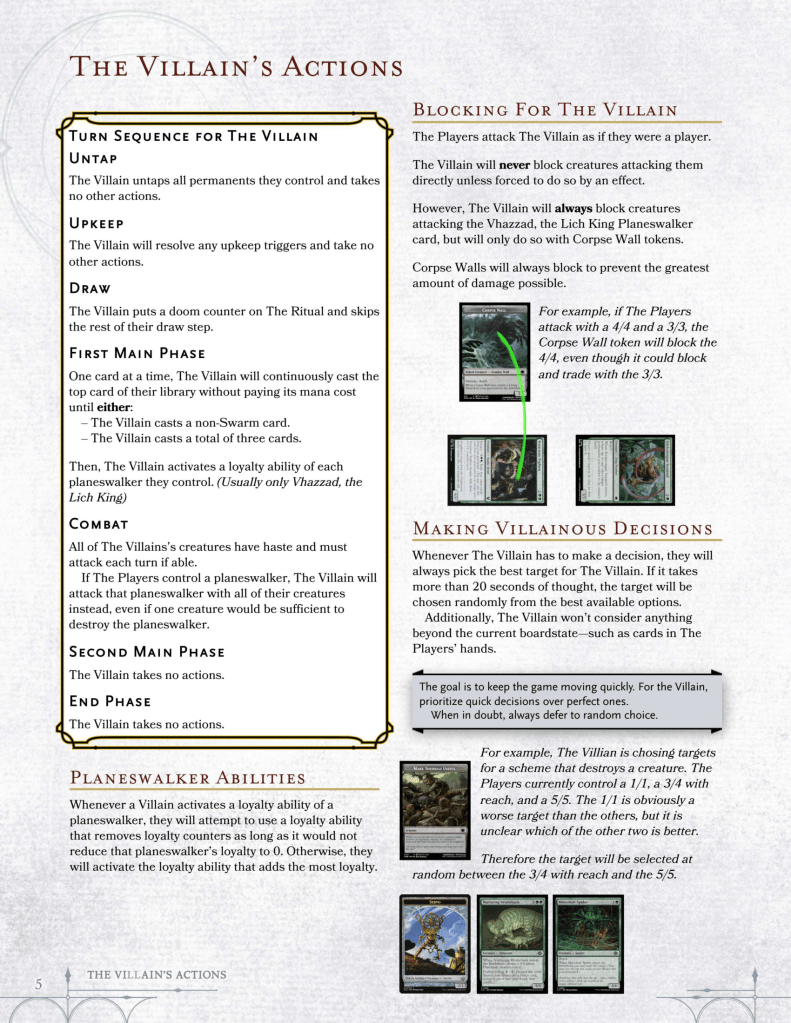
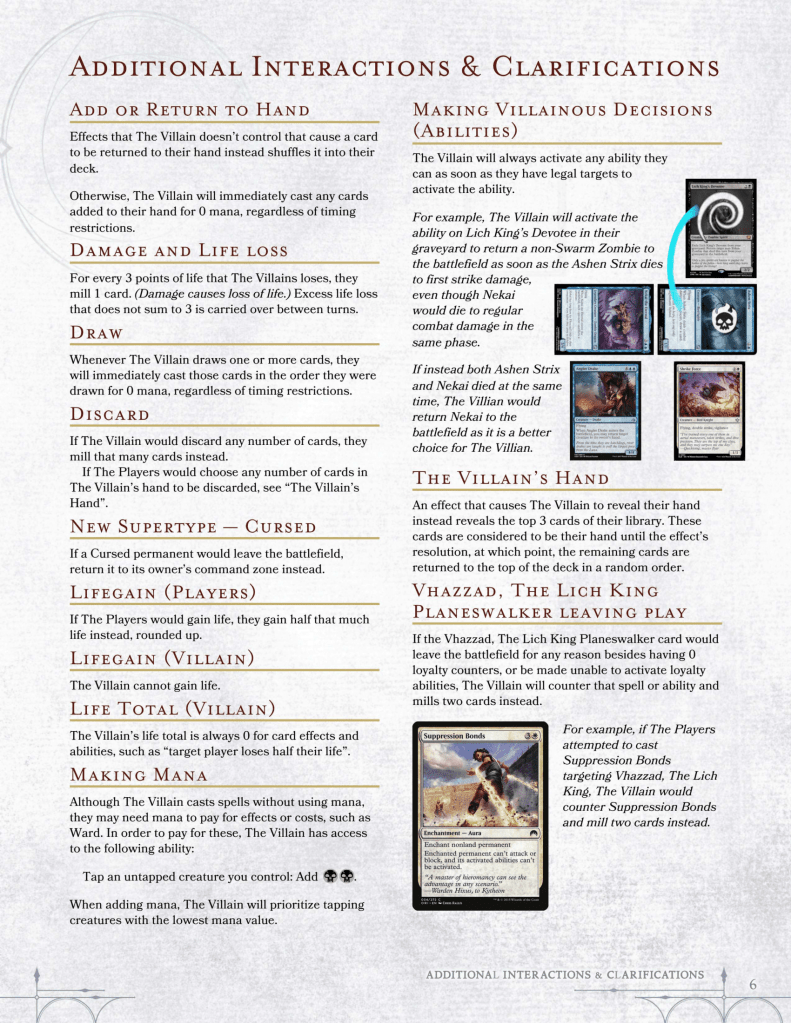

Vhazzad, The Lich King is an alternative format for Magic: The Gathering, designed specifically for 2-player co-op. Click here to view the rules document.
The inspiration came when my girlfriend and I grew tired of playing cube against eachother and wanted a more cooperative experience instead of directly competitive. I had come across a post on reddit from u/direwombat8, who had created their own alternative format for Magic: The Gathering that seemed close enough for what I was looking for, but there were enough issues that by addressing all of them, I had created my own unique experience.
Core Design Considerations
- Cards say what they do.
- Winning decks look like ordinary decks.
- The players experience a dangerous situation.
Cards Say What They Do
Most versions of Horde Magic heavily rely on errata and complex rulings to force existing cards to behave in prescribed manners.
This leads to a lot of additional mental overhead during gameplay which slows down gameplay. The core advantage of using errata and staying closer to printed effects is that players can use cards already in their collection or purchase the cards individually, but I think the negatives outweigh the positives for a format as complex as this.
To remedy this, I created over 40 custom Magic the Gathering card designs. These started as errata’d versions of real magic cards, but expanded into wholly unique cards to fit the needs of the experience.
Winning decks look like ordinary decks
Because of the simplistic nature of the non-player enemy’s behavior, it is very easy to create an environment where the player’s decks get warped to specifically counter the challenges. This means that the challenges that the enemy’s deck presents needs to be best countered with an ordinary deck. This results in the following:
- Players need to have a reasonable mix of cheap and expensive spells.
- Attacking needs to be a required part of gameplay instead of optional.
Since the enemy AI simplistically attacks with every creature every turn, it creates a draw towards playing larger, expensive creatures that allow you to safely sit passively and let the opponent suicide their creatures into yours every turn until you win.
To remedy this, I added effects that force the players to sacrifice creatures, creatures that can only be killed with multiple creatures from the players and even creatures that can only be blocked by small creatures as well. All of these help give players reasons to keep smaller, cheaper spells in their deck to protect and assist their larger creatures. I could push this further, as medium-sized creatures are currently a dominant strategy.
Additionally, to disencentivize the passive playstyle, I formatted the core gameplay experience to center around a Planeswalker card. This creates a ticking bomb that can only be consistently delayed by attacking with creatures. This helps create an interesting tension during gameplay because you have to attack with enough to appropriately delay the bomb from going off, but that comes at a cost to your own safety. This was easily the biggest success of the design, as it consistently creates interesting tension in gameplay.
The players experience a dangerous situation
It is important in this experience that players feel like they could lose right up until they win, without relying solely on luck. In many versions of horde magic, because the enemy’s deck is randomized each time, the format inherently has a massive amount of variance.
The Ritual was my primary solution to the natural variance, which guarentees that a very bad thing will always happen to the players at a predictable timing point. The randomized outcome of which terrible thing will happen also forces the players to account for more posibilities while keeping gameplay varied enough that it doesn’t get stale after multiple playthroughs.
The other way that players can fail to experience a dangerous situation is when they amass a winning position too early and the enemy lacks the resources to appropriately fight back. Some of the scheme cards present a negative feedback, hurting the players more if they’ve amassed a winning position more than if they’re already low on resources. This is another aspect that could continue to be tuned, with effects that punish players *less* if they’re low on resources, but it is difficult to align that narratively.
 percegaming
Leave a comment